
Killing someone does not make his stuff yours.
Home
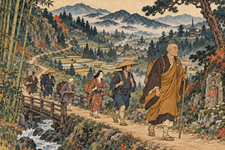
For Iga around 1580, travel depends upon local authority, the purpose of the journey and who can vouch for the traveller. There is no single passport that guarantees passage throughout Japan. The more systematic Tokugawa network of permits and checkpoints belongs to the later Edo period.
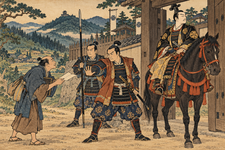
Banking in Iga operates through merchant houses, moneylenders and trusted associates. They provide credit, arrange payments and convert goods into spendable wealth. Borrowing bridges the interval between expenditure and income, allowing households, workshops and warrior families to meet obligations before their revenues arrive.
Seven houses shape northern Iga, gathering lesser warrior families around mountain holds, cultivated valleys and guarded roads. Their authority rests upon overlapping claims: inherited land, military service, marriage, shrine patronage and agreements between neighbours. No house commands enough men or wealth to dispense with the others. Their children grow up across these boundaries, sometimes as spouses, sometimes as wards whose continued residence guarantees peace.
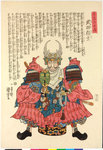
A daimyō sits at the centre of a network of households, land rights and obligations. His power depends on people who collect his revenues, hold his castles and bring armed followers when summoned.
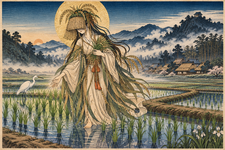
A god appearing at a shrine proves its presence, but leaves open why it deserves worship, whether its demands are just, and who may speak in its absence. Power can compel obedience without earning devotion; a blessing can reward a bargain without endorsing a priesthood. Nor does one god’s testimony settle the claims of another, especially where their interests conflict. Temples and rulers must still turn encounters into doctrines, favours into precedents, and particular acts into lasting authority—each step offering room for ambition, misunderstanding and fraud. The sacred becomes a demonstrable presence, while the legitimacy claimed through it remains thoroughly contestable.
A temple bell carries across the fields. Travellers leave offerings beside the road, and mountain ascetics climb towards places the villagers seldom visit. Religion belongs to the province’s daily life: remembering the dead, asking protection, keeping festivals and tending relationships with powers beyond the household.
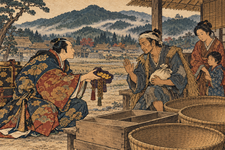
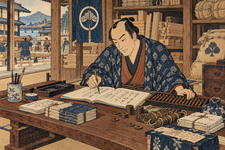
A lord’s command requires provisions. A merchant’s promise requires trust. A purse of gold requires someone with grain to sell. Across Japan’s warrior households, temples, villages and markets, finance connected need with surplus—and helped determine who could make things happen.
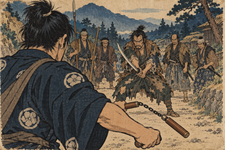
We are playing a collaborative storytelling game. Much of the play lies in understanding another person’s position, and deciding what we are prepared to do about it. If we abandon every uncertainty to the dice, we spend our time reinterpreting whatever they produce, trying to make a tale out of it afterwards. “The dice are telling the story tonight” can mean the GM has handed some of his responsibilities to a few pieces of metal rolling around a table. Chance has its place, but we still have to decide what deserves to be left to chance.