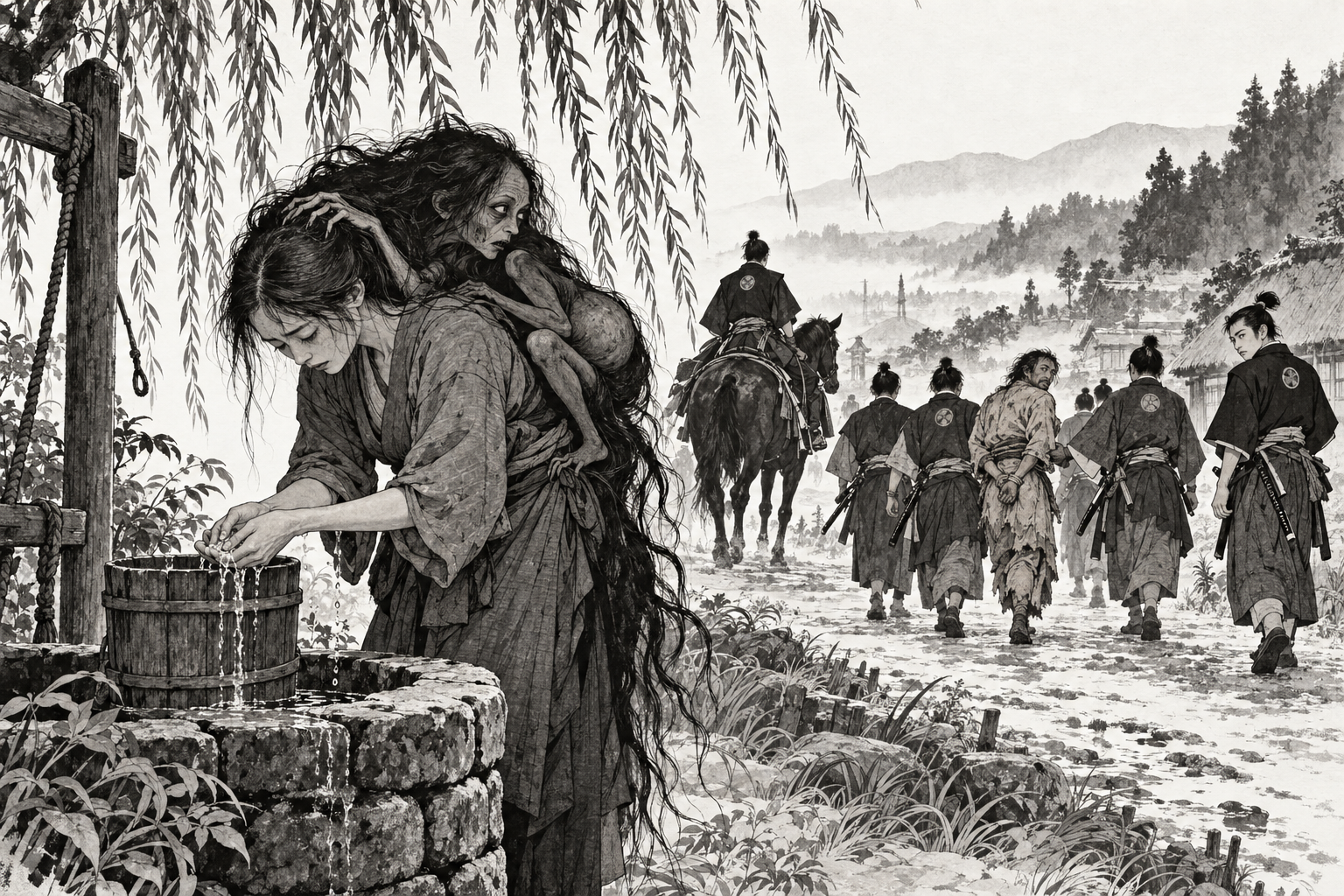
"The woman bent beneath it, though she believed the weight was her own tiredness.
It lay along her back with its knees tucked beneath her ribs and its fingers buried in the warm roots of her hair. When she straightened, it tightened. When she stooped, it settled more comfortably. All day she had carried it, the chill in the warm sunshine, through the small movements of her life, feeding it almost nothing.
There had been a little bitterness at the market. A little envy. The man in the fine indigo robe had turned the bucket in his clean hands while she counted her coins again. The spirit had lifted its head then, nosing towards the small hurt beneath her breast. But she had paid, and the hurt had passed. The bargain leaks its load with the strain of future journeys added to the shadow weight.
Now there was water.
The spirit watched it climb the wooden sides of the bucket. It watched the dark wetness spread between the staves, closing their narrow mouths. Everything could be filled. Everything could be made to hold what entered it.
Beneath its swollen belly, the woman remained warm and empty.
Hooves sounded behind them.
It raised its head before she did.
A dark horse moved along the road, carrying a man whose body scarcely troubled itself with the journey. Scarlet cords flickered against the animal’s neck. The woman liked the colour. A fan, she thought.
The spirit pressed its cheek against hers. Let her have the thought. Let her picture the fan opening in her hand, the fine robe, the eyes lifting towards her.
Behind the horse came young men.
Their heat reached it through cloth. Their steps struck firmly into the earth; their bodies expected the next step to be there. Beneath loose sleeves, hands rested near polished things at their hips. It scarcely attended to those. It searched their faces, their mouths, the soft places where a glance might enter and remain.
It shifted its weight.
Sayo’s shoulder dipped. The bucket tilted on the stone lip of the well, and water spilled over her fingers.
Yes. That.
It drew her head a little to one side. Loosened a strand of hair against her cheek. Held her there with the bucket slipping, caught in a small difficulty that a man might stop to put right.
Its will into them. Look again.
One did.
Only the last. His eyes touched her wet hand, travelled a little, then hurried back to the road.
The spirit stretched after him. Its fingers tightened in her hair. For a moment it felt the beginning of something: a warmth turning inward, an image of her carried beneath his clothes.
Then he swallowed it down.
The hunger opened wider.
Between the men came another body, badly arranged. His feet hurried beneath him while the cord pulled his shoulders back. Mud, torn cloth, old blood. Each tug passed through him before his legs could answer.
The nestled shadow tasted for his fear and recoiled. Resolve seeking compassion. Know my struggle. There was so much of it that it smothered everything else.
Yet he kept looking at her.
Again, and again.
His gaze offered no warmth to follow. It pulled at her instead, asking her to see the cord, the blood, the direction of the road. Asking something of her that the spirit could neither swallow nor understand. Not him.
Under its belly, the woman’s breath changed.
It bore down on her shoulders. Her arms trembled as she steadied the bucket.
Lower your eyes.
She did.
The men continued towards the north road. The bound one stumbled sideways, still trying to keep her face in sight.
Clinging to her back, the spirit watched the young men carry their warmth away. Its mouth worked beside her ear.
Water slipped between her fingers. None of it reached her mouth.
Its hunger knew patience"
What stands out in a scene should depend upon the skills and attention of the character looking. A craftsman may notice the bucket’s workmanship, a warrior the escort’s weapons and spacing, a priest the weight beneath the woman’s weariness.
This does not require a separate description for every character. Choose one character’s gaze to shape most of the telling, giving the scene the details that would catch that person’s eye. Then let everyone’s questions draw out more, adjusting what you reveal according to their knowledge, interests, and actions.
The scene remains shared, while each character has a different way into it.
"The priest watched her shoulders remain bowed after she rested the bucket on the stone. His own grew heavy. Long trances had made him attentive to such impressions: a pressure beneath the neck, a coldness close against the spine, the effort a breath required when something seemed to settle upon it. He let the feeling remain. As the young men passed, it shifted forward; when their eyes turned away, it sank again. Beneath her hair, the shadow seemed gathered too closely against her back.
When the captive sought her gaze, she began to lift her head. The priest felt the weight tighten, and she lowered her eyes. Weariness might explain her posture, but that movement troubled him. He suspected more cause than could be counted among her ordinary burdens, stirring at the promise of desire and bearing down when compassion drew her attention elsewhere.
He watched another moment, quietly counting his breaths."
Home