
The bucket maker steadies a cedar stave and draws his plane along its edge, a thin curl of pale wood falling among the shavings at his feet. Each narrow board must fit its neighbours closely enough to hold water; assembled around a fitted wooden bottom, they form an oke, an open-topped bucket. He taps woven bamboo hoops down around the body, tightening their grip until the joints close.
There is no glue. Carefully fitted wood and the pressure of the hoops hold the vessel together; wetting makes the wood swell and tightens the seal. The principle is old, shared with barrel makers far beyond Japan, but every bucket depends upon the maker’s judgement. At the spring market, a merchant in a finely woven indigo robe turns the finished vessel in his hands that have never known a housed blade tearing precise strips shaping wood, showing its smooth interior to the woman considering its price.
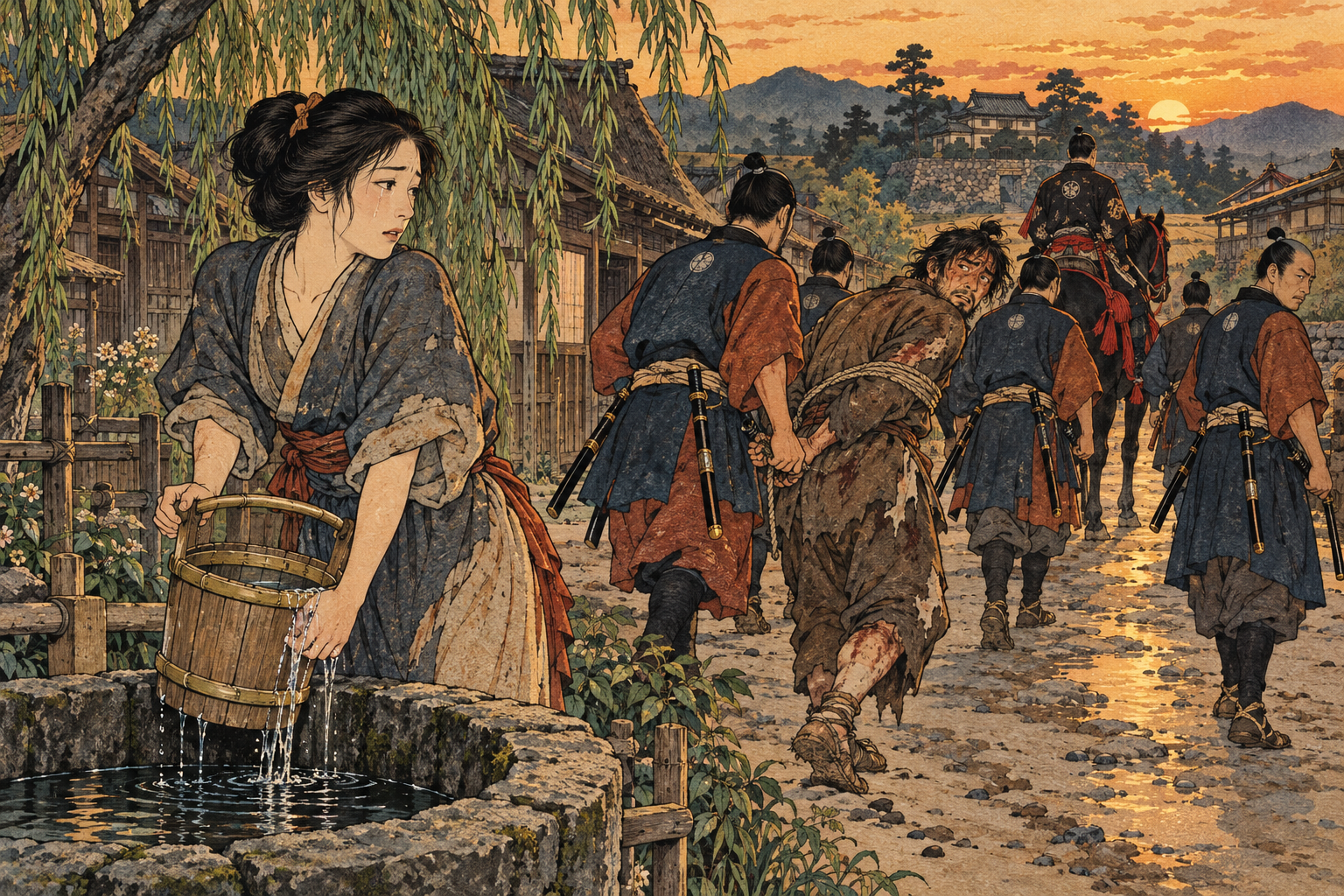
The cord securing the handle of the oke pulled taut as Sayo lifted it onto the stone lip of the well. Hooves sounded on stone and soft mud; the road behind her. She looked up, leaving the bucket tilted, and clear liquid welling over her fingers.
A dark horse passed, its shoulder gleaming, scarlet cords rising and falling against its coat. Above it, deep blue cloth spread broad and angular across a man’s shoulders, the loose sleeves stirring as his hands made small, precise movements over the reins. Six men followed on foot. Russet, indigo, a flash of pale lining: their clothes shifted with each stride, generous folds falling from their waists towards the dusty road. Gold gleamed at their hips. Long, glossy curves of black and reddish brown swung beside them, catching the early evening sunshine. Sayo’s eyes returned to the scarlet at the horse’s neck. A fan in that colour, she thought, would be something to own.
Between the men, another, feet moving without rhythm. Bent, his shoulders hunched and his head drawn awkwardly back. Hurried he was, trying to catch up with each pull. His robe hung torn at one shoulder, brown? Mud streaked his knees, and dried blood marked him. As he twisted, Sayo glimpsed his hands behind him, wrapped in chord. The cord, continuing around his body with a clever economy had the better of him.
The man beside him gave a short tug, completing the puzzle of the step, as though leading an unwilling animal to its destination. All saw, none turned towards the well. Only the last let his gaze slip to the clear water spilling over Sayo’s fingers, then brought it sharply back to the road.
The bound man kept looking back, craning his neck, seeking a commonality in her set, stumbling sideways to hold her gaze long after the other had looked away. Sayo steadied the bucket and lowered her eyes.
So when asking after their companion, you could tell the players some peasant says she saw him being carted off towards said grove on north road.
But why not add a little detail to suggest a larger world. By skipping to whats seen as opposed to whats known or assumed folk have their own experience of the moment.
When framing any interaction in the game try to put a person experiencing it into the telling. It will bring out the person in the character being played back.