
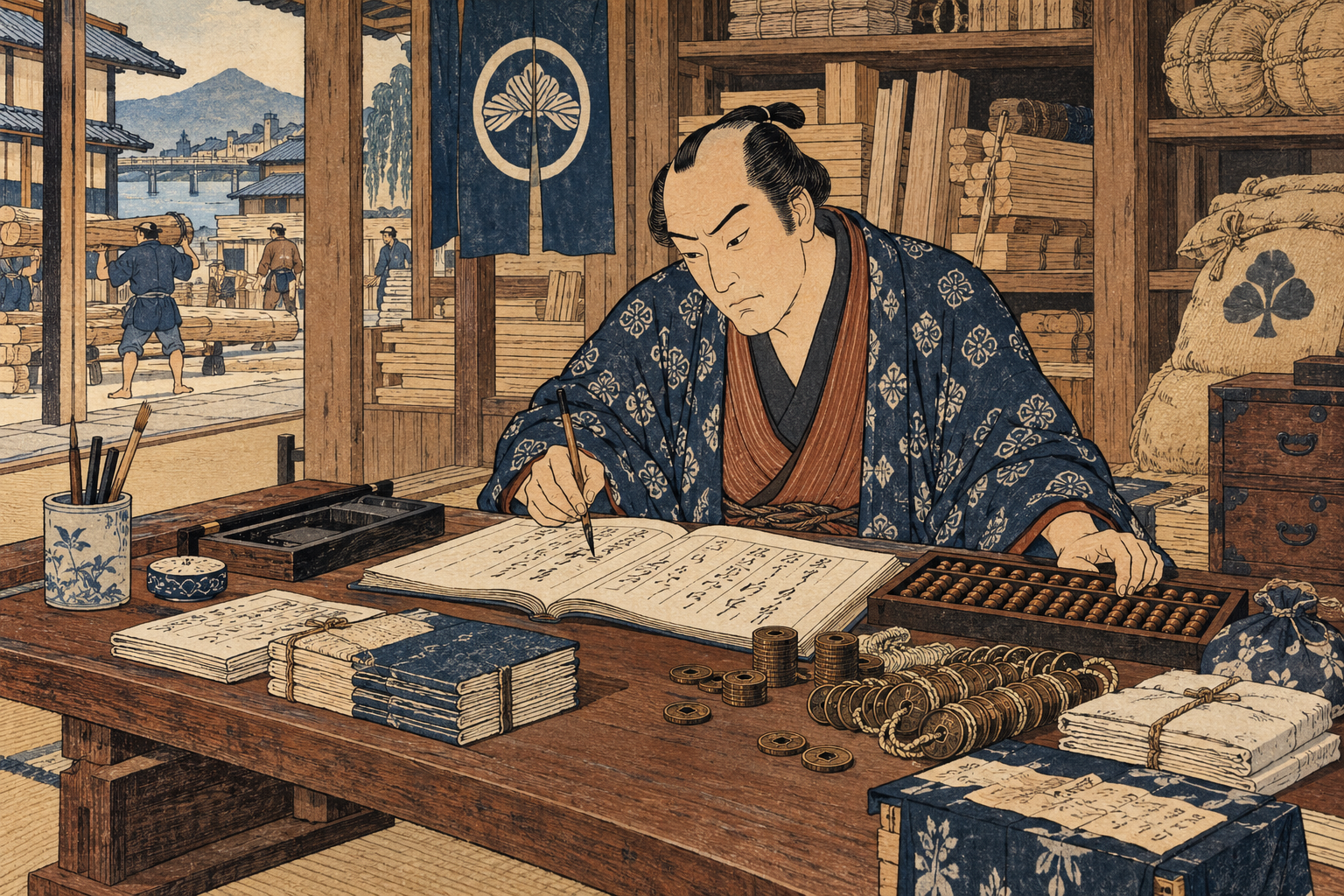
A lord’s command requires provisions. A merchant’s promise requires trust. A purse of gold requires someone with grain to sell. Across Japan’s warrior households, temples, villages and markets, finance connected need with surplus—and helped determine who could make things happen.
This is a longer article bashed out as conversation with an ai agent, then a series of structured positions which i asked chat to flesh out. Its worth a read for the feel of the setting in and of itself. If you cannot follow the abstraction of wealth, and those who specificaly work comparative advantage in its production, which includes lords as much as merchant classes, then much of the force which moves the pieces on the board will remain opaque to your inquiry.
We dont need the companies accounts for a daymios clan to make the game real, but a suggestion they exist and an idea they also influence his decisions allows us to discover more tale to tell, when we choose to go looking for it.
Money, Rice and Power
Finance and its limits in Japan, c.1500–1800
Finance changed what could happen, when it could happen, and who could make it happen. A harvest was seasonal; military expenditure, household consumption and commercial purchases could not always wait. Loans, pledges, bills and merchant accounts bridged those gaps. They also changed who controlled property and who could exercise authority. In Japan between the sixteenth and eighteenth centuries, the movement of wealth helped determine whether a household survived, a merchant expanded, or a lord could turn a command into action.
Land, rice and goods were stores of wealth. Money made much of that wealth transferable, and credit made an expected future resource available in the present. A lord might command a valley yet lack the funds to provision its defenders. A merchant might have no right to command those men, yet possess the resources that allowed them to march and halt them with its withdrawal. Finance brought these different kinds of power into negotiation.
The mechanisms developed over time. Sixteenth-century Japan already possessed moneylending, pledged property and long-distance payment arrangements. Under Tokugawa rule, established in 1603, interregional commerce supported larger financial networks. By the eighteenth century, merchant banking, domain notes and organised rice futures trading offered additional ways to mobilise wealth. An Osaka financier of 1750 operated in a different institutional world from a lender in Iga around 1580.
Need, surplus and time
A merchant’s opportunities arose from differences in supply, demand, location and timing. Moving grain from surplus to shortage earned a trading margin; advancing funds until repayment earned a lending return. Both depended upon someone having a resource another person needed. Finance added the ability to bargain over when that resource became available and what the recipient would surrender in exchange.
Scarcity shaped the terms of a bargain. A borrower with time, reserves and alternative lenders could negotiate. A household facing an immediate payment with few alternatives had less room to refuse. Conversely, plentiful goods did not guarantee plentiful money: a merchant could own a valuable cargo while being unable to pay a debt until it sold. Financial advantage depended upon usable resources at the required moment.
Coin itself introduced complications. Sixteenth-century circulation included Chinese copper coins and private imitations of varying quality, encouraging coin selection, or erizeni. Gold and silver became more important as mining expanded. Tokugawa issues from 1601 and Kan’ei copper coinage from 1636 helped establish a system combining denominated gold, silver valued by weight and copper cash. Conversion between monetary forms created a service from which moneychangers could profit. [1]
The instruments of finance
The principal instruments and arrangements can be distinguished by the problem they solved and the return they offered. Their availability and legal treatment varied across regions and periods.
| Vehicle or arrangement | How it was used | How it produced a return or advantage | Historical placement |
|---|---|---|---|
| Interest-bearing loan | Resources advanced against an obligation to repay | Interest; continuing influence through renewal of credit | Established before and throughout the period |
| Pawn or secured loan | Possessions or property rights pledged against borrowing | Interest or income from pledged assets; possible forfeiture | Medieval precedents; developed Edo forms |
| Farmland pledge, shichichi | Land secured an advance, sometimes with possession transferred for the term | Harvest income or rent; potential lasting control after default | Particularly well documented in Edo rural finance |
| House-and-grounds security, kajichi | Urban property supported borrowing | Lending return; security against loss | Important in Edo urban finance |
| Bill of exchange | Payment arranged through an associate elsewhere | Remittance business and reduced cash-transport costs | Medieval saifu; later Edo kawase tegata networks |
| Deposits and merchant-house lending | Funds held and employed within a financial business | Returns from lending or other use before repayment fell due | Developed within Edo merchant finance |
| Loan against expected rice revenue | Ruling households obtained funds before revenue was realised | Interest; a continuing role in domain finance | Prominent in the Osaka-centred Edo system |
| Rice bill, kome-kitte | A claim upon rice traded through the warehouse market | Commercial dealing without repeated physical movement of grain | Late-seventeenth-century Osaka onwards |
| Rice futures | Positions taken for later settlement linked to rice prices | Price-risk management or speculative profit | Dōjima officially recognised in 1730 |
| Merchant paper and domain notes, hansatsu | Issuers supplied locally accepted paper means of payment | Easier settlement; domain fiscal financing | Early paper around 1600; domain issues in the Edo period |
| Mutual credit, tanomoshi-kō or mujin-kō | Members contributed to a pool allocated successively | Earlier access to a lump sum or organised saving | Medieval roots; widespread Edo use |
The instruments above span several centuries. Their dates matter: the practices of an eighteenth-century Osaka merchant should not be assumed for a sixteenth-century Iga household. Sources are listed at the end of the article. [1–9]
A lord might command a valley yet lack the funds to provision its defenders.
Turning trade into lending
Moneylending long preceded the Tokugawa settlement. Medieval Kyoto’s sake brewer-lenders show how an existing business generated capital for another. Dosō were associated with storehouse lending; sakaya were sake businesses, some of which also lent money. Commercial receipts could be recirculated as loans, producing income beyond the original trade.
Their protection was partly institutional. Suzanne Gay’s study describes brewer-lenders tied to overlords, notably Enryakuji, and prominent lenders serving as tax agents for religious institutions, the shogunate and the imperial court. Trade, lending, taxation and religious authority could meet within the same network. [2]
Such connections provided a measure of insulation from hostile demands, but also created dependence upon a patron. The merchant’s position was strengthened by protected access to business and enforcement. The institution benefited from the merchant’s capital and services. Financial power could grow through established authority as well as challenge it.
Debt, property and dependence
Security reduced a creditor’s exposure by connecting a loan to identifiable property. The borrower obtained resources now; the lender gained a claim that might survive the borrower’s inability to pay. Written terms mattered because they helped determine whether default led to renegotiation, continued income from an asset, or its loss.
In Edo urban finance, kajichi arrangements used houses and grounds as collateral. Rural shichichi used farmland. Some land pledges transferred possession to the creditor, who could cultivate the land or lease it, including back to the borrower. Harvest income or rent could function as the lender’s return without an explicit interest clause. [3]
A farmer might pledge a field after a failed harvest. The advance meets an immediate need, but rent now goes to the creditor. The farmer continues cultivating familiar ground while retaining less of its benefit. A renewed difficulty can prevent redemption. Financial need has changed the household’s future income, making another need more likely.
Default could therefore help concentrate assets, although foreclosure was neither automatic nor unrestricted. The 1643 prohibition on permanent farmland sales coexisted with accommodation of land-backed credit. Village authentication, legal protection and redemption practices complicated transfers. [3] The creditor’s security depended upon an authority willing to recognise the claim; the same authority could constrain its exercise.
Moving money across distance
A bill of exchange arranged payment elsewhere through a network prepared to honour it. Medieval saifu combined functions associated with payment orders and promises to pay. Their use declined in the sixteenth century, while other remittance arrangements continued. Kawase tegata became important within later-seventeenth-century networks connecting Osaka, Kyoto and Edo. [4]
A customer might pay a trusted merchant in one city and receives a document enabling payment through an associate in another. The document travels instead of the full cash sum. The merchants settle through their wider business dealings. The arrangement reduces transport costs and makes distant transactions easier to undertake.
The resulting advantage belongs partly to the network’s operator. Access to reliable payment can attract business and make customers dependent upon continued service. Yet the document remains exposed to commercial failure: an authentic bill drawn upon a failing house may not be paid. Confidence in the people and accounts behind the instrument is part of its value.
Merchant banking: making time pay
Ryōgaeya, or moneychangers, worked between monetary forms and regional trading practices. Some developed deposit, lending and remittance businesses. Osaka’s silver-oriented commerce and Edo’s gold-oriented payments made exchange expertise particularly useful. [4]
Mitsui opened an Edo exchange business in 1683 and obtained official shogunal remittance work in 1691. Government funds received in Osaka could be matched by payments from Mitsui’s Edo commercial receipts, avoiding transport of the same metal. The interval before final payment allowed funds to be employed in business. [5]
Here time itself became a financial resource. Money received now but payable later could earn a return in the interval. The accompanying obligation remained: the house had to be able to settle when payment fell due. Profitable use of funds and continued ability to repay were different requirements.
Merchants and lords
Tokugawa lords sold tax rice and borrowed against expected revenue. By the late seventeenth century, Osaka was a major centre for both activities. Ruling households’ financial room therefore depended upon rice prices and the cost of credit. [6]
A domain might borrow before harvest revenue arrives. A fall in rice prices then reduces the cash raised by the same quantity of grain. The domain must find additional resources, cut expenditure or seek new terms. Market conditions have altered what its authority can accomplish.
A merchant’s leverage lay partly in access to the next advance. A lord’s dependence upon continuing finance could encourage repayment and negotiation. Yet the merchant could not simply foreclose upon a domain. Recovery from rulers was difficult, and official orders compelling repayment were far from assured. Goyōkin, semi-forced loans or contributions sought by government, exposed private wealth to demands from above. [6]
Financial strength therefore did not remove subordination to temporal power. A creditor could hold enforceable security against an ordinary borrower while lacking comparable remedies against a lord. Lending to authority might bring valuable connections and business, but the borrower’s political power could also weaken the lender’s claim.
The protection of authority
Mitsui’s eighteenth-century operations show how protection could alter the value of a financial claim. Its archive describes loans formally associated with official remittance business and benefiting from strong judicial protection. It also records property-secured lending, assets acquired through forfeiture, and caution about direct loans to lords because of default risk. [9]
This was a concrete form of insulation: lending conducted under a privileged institutional heading enjoyed support unavailable to every private creditor. Mitsui also limited exposure by favouring certain secured arrangements and, in some cases, lending to merchants acting for lords rather than directly to the lords themselves. [9]
Finance and authority were interdependent. Political protection could make a claim more recoverable and therefore more attractive to hold. Commercial competence could make a merchant useful enough to secure that protection. Such arrangements could also favour connected creditors over others, directing the exercise of authority towards particular financial interests.
Rice bills and futures
Rice bills, or kome-kitte, allowed claims associated with rice to be traded without moving grain at every transaction. The late-seventeenth-century Osaka market developed trading in domain tax-rice bills and moved to Dōjima around 1697. In 1730 the shogunate officially recognised its rice-bill spot market and futures market. [7]
A spot bill concerned a claim upon rice through the warehouse system. A futures position concerned later settlement linked to prices. Membership and clearing arrangements supported organised trading. [7] A trader could reduce exposure to an unfavourable price movement; a speculator could accept exposure in pursuit of profit.
These instruments changed who bore uncertainty. They made positions easier to trade and risks easier to redistribute, but neither created grain nor guaranteed a harvest. An orderly market still depended upon production, credible claims and continued settlement.
Paper currency and mutual credit
Around 1600, Yamada hagaki appeared in the Ise area as receipts associated with deposits and small-change settlement. Merchant paper and domain notes, hansatsu, followed. Domain issues addressed monetary shortages and fiscal needs under changing shogunal restrictions. [1]
Issuing accepted paper expanded an issuer’s ability to make payments without immediately supplying the equivalent coin. Acceptance depended upon confidence and the opportunities to spend or redeem it. The recipient acquired a claim whose usefulness could change with the issuer’s fortunes.
Tanomoshi-kō and mujin-kō supplied another route to finance. These mutual associations had medieval roots and widespread Edo use. Members contributed periodically to a pool, allocated successively under agreed rules, sometimes by lottery or bidding. Recipients continued contributing after receiving their share. [8]
The association assembled useful sums from smaller contributions. It could give households access to funds without a great merchant patron, although dependence upon fellow members replaced dependence upon a single creditor. One participant’s failure could become a shared loss.
Where money fails
Money’s strength depended upon what it could obtain. Gold could retain its metal content while losing much of its command over rice. Silver could settle a debt yet fail to secure the supplies needed to continue a business. A purse represented purchasing capacity within a working system of production, transport, acceptance and exchange. When one of those connections failed, possession of money ceased to guarantee the intended outcome.
The first limit was physical. Coin could attract grain from another district, pay carriers and encourage additional production, but these responses required available supplies, open routes and time. It could not replace an exhausted local storehouse immediately. During a shortage, a larger payment might secure someone else’s remaining food without increasing the total quantity available. Financial power could decide who obtained a scarce resource while leaving the scarcity itself unresolved.
Selling a reserve exchanges something that can be used directly for dependence upon a future market.
Selling today, buying tomorrow
A household might sell grain to meet a tax demand or repay a loan. It receives money, but parts with something it could otherwise eat. The bargain assumes that food will remain available later at a price it can afford. If the next harvest fails, prices rise or shipments cease, the household may be unable to replace what it sold. Even a sum larger than the original sale proceeds may purchase less grain; where no seller is accessible, increasing the offer cannot secure an immediate meal.
Selling too much therefore exchanges a physical reserve for a dependence upon future markets. The danger is especially severe where other households are making the same calculation. An apparent local surplus may leave the district, while the money received remains as claims upon supplies that must now come from elsewhere. Future safety depends upon those supplies arriving and their holders being willing to sell.
This was a risk to be managed, rather than a reason all trade was ruinous. Sale proceeds could buy a greater quantity of cheaper food, fund productive work or meet obligations essential to keeping land. The causal question was what the household surrendered, what it expected to obtain later, and how secure that expectation proved. Money did not itself preserve the future option to eat.
Scarcity, glut and the value of coin
Scarcity and glut could undermine financial power in different ways. A shortage of goods raised the price of obtaining them, reducing the practical force of a given sum. An abundant harvest could lower grain prices, improving the buyer’s position while weakening the seller’s ability to raise cash. A rice-revenue household might consequently struggle to meet monetary debts during agricultural abundance. Plenty in its storehouse and weakness in its accounts could coexist.
The quantity and quality of currency also mattered. The Bank of Japan’s historical account describes the Genroku recoinage of 1695 and Hōei recoinages of 1706–1711 as debasements that enlarged circulation, benefited government finances and brought inflation. The higher-fineness recoinage of 1714 sharply reduced circulation and contributed to falling commodity prices and economic stagnation. [1]
These episodes show why better metal did not automatically produce better financial conditions. An expansion of money could erode purchasing power; a contraction could make payments and business harder to sustain. A debtor receiving less money for produce could struggle to discharge an unchanged monetary obligation. Monetary strength had to be judged against prices, access to currency and the commitments already made.
Gold and silver also formed different monetary media, requiring exchange. A valuable holding was not necessarily available in the form needed for a particular payment. Conversion added dependence upon an intermediary and the terms offered at that moment. The metal’s physical durability did not make its purchasing or exchange value constant.
When authority closes the market
Even where food existed elsewhere, political decisions could prevent money from reaching it. Research on Tokugawa famines describes emergency restrictions on grain shipments, relief from taxation, releases from public granaries and limits upon converting rice into sake. It also identifies a conflict between retaining food locally and fulfilling earlier commitments to outside merchants. Some lords risked local shortages to preserve their standing as suppliers; repeated harvest failures could eventually lead to default. [10]
Here authority set a limit upon the market’s reach. A purchaser with funds might be prevented from importing grain. A creditor with a contract might discover that continued enforcement endangered the population upon which the debtor’s revenues depended. A lord might have to choose between protecting future access to finance and protecting present access to food.
Political intervention was not simply an external disruption of a neutral market. The market already depended upon protection, recognised claims and permitted movement. In crisis, the competing purposes of that authority became more visible. A financial promise could be sound under ordinary conditions yet become politically impossible to fulfil.
When promises outnumber usable resources
A bill, note or deposit claim remained useful only if payment or redemption could be secured. The prospect of repayment could fail through insolvency, interrupted trade or refusal. Property security might reduce a lender’s eventual loss while offering little immediate help: a claim upon a house was not the same as cash available to meet today’s obligations.
The same distinction applied to political protection. A privileged creditor might possess strong legal standing, yet still face a borrower without the resources to pay. Enforcement could transfer property or redirect income. It could not restore a failed harvest. Rights, liquidity and physical supplies were related forms of security, but they were not interchangeable.
Wealth and the means to survive
These limits made it reasonable to value stores, productive land, varied sources of income and dependable relationships alongside money. A household retaining grain possessed a resource it could use directly. A household retaining cultivation rights possessed a prospect of future production. An associate with transport or local access might be more useful during a crisis than a distant promise to pay.
These pressures did not produce a single outlook shared by everyone. People differed in resources, occupation and experience. Commercial opportunity could also encourage confidence that future needs would be met through purchases. A study of Shimotsuke farmers traces increasingly market-oriented rice production from the late seventeenth century, and later describes households whose dependence upon other earnings and purchased food left them insufficiently prepared for renewed famine. Its early-nineteenth-century examples extend beyond this article’s main period but show that memories of shortage did not enforce permanent caution. [11]
The tension was between obtaining an advantage now and preserving the means to survive later. A sale could be profitable while weakening a reserve; a loan could prevent immediate ruin while surrendering future income. Financial prudence involved judging both. For players and game masters, that gives a household a credible reason to refuse an apparently generous offer: the goods requested may be its remaining protection against an uncertain season.
In the Iga setting, the mountain lord’s gold might be accepted everywhere along the valley and still fail to provision the watch. The granaries have emptied, a neighbouring lord has closed a pass, and the remaining farmers will not sell their seed or their families’ food. The merchant can offer another advance, but cannot promise delivery. At that point, the outcome turns upon access to supplies, labour, routes and cooperation. Money remains influential, yet its ability to cause the desired result has reached a material and political limit.
Money and consequence in Iga
For the late-sixteenth-century Iga setting, around 1580, the strongest historical foundations are mixed coin circulation, payments in produce, merchant and storehouse lending, pledged property, written obligations and personal payment networks. Religious patronage and overlapping commercial and official roles provide models for protection and influence. Mature domain currencies, the large Osaka–Edo banking networks and Dōjima futures belong to later developments unless deliberately adapted into the fantasy setting.
A mountain lord might borrow to provision a watch post before revenues arrive. The merchant advances supplies against repayment or a pledge. A bad harvest then prevents settlement. Further supplies become conditional upon new security, preferential access or payment ahead of another obligation. The lord retains his title while losing freedom to allocate resources; the merchant gains influence while becoming more exposed to the household’s survival and goodwill.
The watch dwindles, and the mists of the goblin paths creep closer. A ghostly bakemono lord gains an approach to the human world. That supernatural outcome begins in a chain of ordinary decisions: a need met by an advance, an expected surplus that fails to appear, a claim pressed upon scarce resources, and an obligation postponed. Finance supplies the connections between those events. It gives the game master causes to follow and the characters relationships through which an outcome can still be changed.
Sources and further reading
- Bank of Japan Currency Museum, Historical Events and Currencies in Use
- Suzanne Gay, The Moneylenders of Late Medieval Kyoto, University of Hawai‘i Press (2001), publisher description
- Private Financing in Early Modern Japan, Japanese Research in Business History 41 (2024)
- Money Markets and Trade, LSE discussion paper
- Mitsui Public Relations Committee, entry into moneychanging and official remittance business
- The Financial Dealings of the Lord Class, Japanese Research in Business History 41 (2024)
- Japan Exchange Group, Dōjima Rice Exchange
- On the Development of Rotating Credit Associations in Japan
- Mitsui Bunko, Moneychanging Business: Structure and Development
- Market Integration and Famines in Early Modern Japan, 1717–1857
- Food and Agriculture in Northern Kantō during the Edo Period (2018), Agricultural History Research