
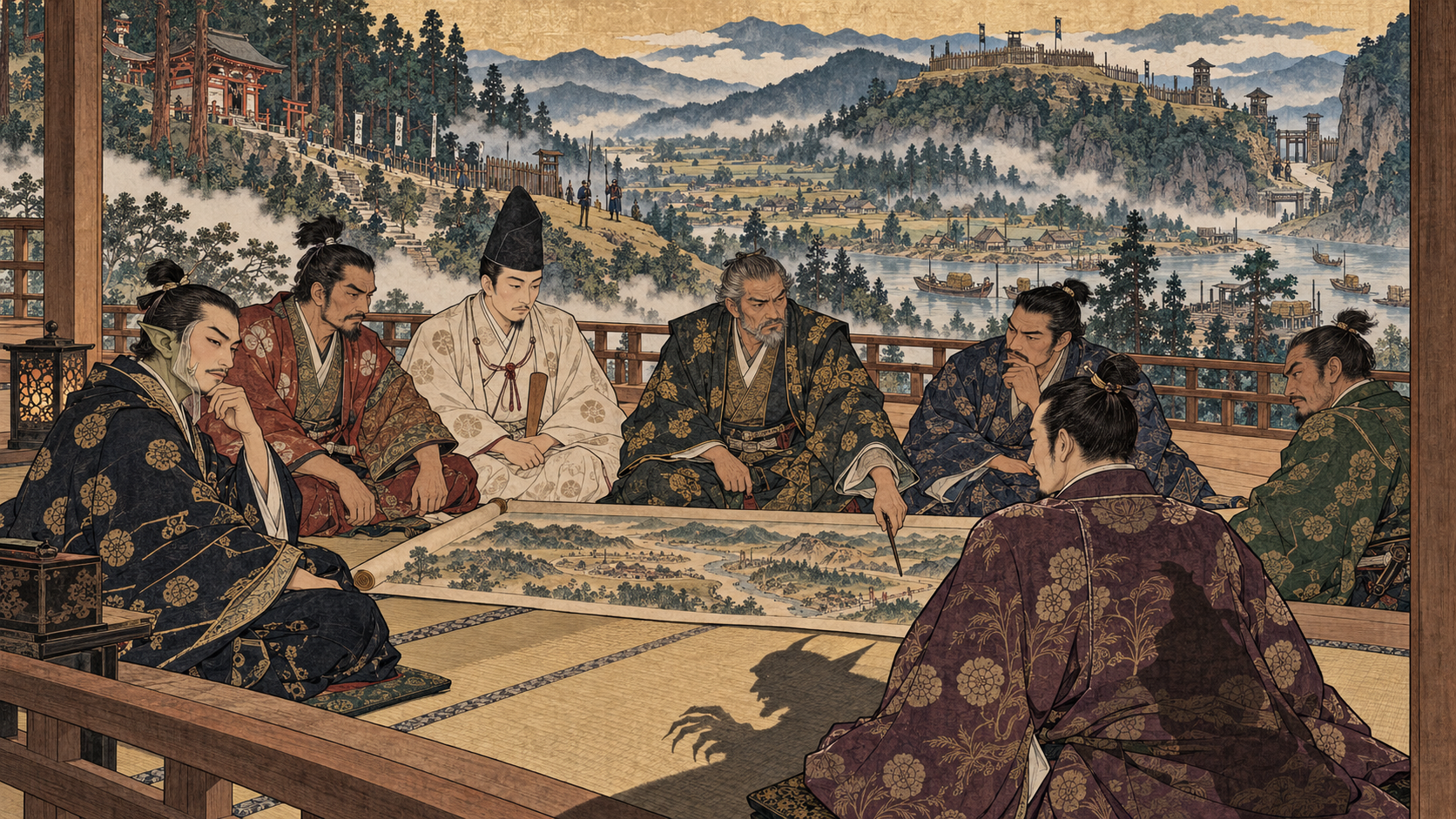
Seven houses shape northern Iga, gathering lesser warrior families around mountain holds, cultivated valleys and guarded roads. Their authority rests upon overlapping claims: inherited land, military service, marriage, shrine patronage and agreements between neighbours. No house commands enough men or wealth to dispense with the others. Their children grow up across these boundaries, sometimes as spouses, sometimes as wards whose continued residence guarantees peace.
The Hattori
Hattori Masanobu, forty-nine, holds a long fortified ridge above an important road. Four or five villages sustain his household, whose closely related warriors know every approach through the surrounding hills. He can make an invasion costly, but struggles to maintain men away from home.
His wife, Tsuru, is a Kitakata daughter. Their eldest son, Masanaga, twenty-five, commands the ridge defences; their daughter, Ito, eighteen, remains unmarried while competing households propose alliances. His younger son, Masayoshi, fifteen, resides with the Kitakata as security for their road agreement.
At Masanobu’s court lives Kitakata Yoshiharu, sixteen, the Valley Keeper’s second son. He and Masanaga train together. Their friendship makes the recurring quarrel over tolls awkwardly personal.
The Kitakata
Kitakata Yoshimasa, forty-six, governs a fertile valley of scattered villages, irrigation works and modest fortified residences. His larger agricultural base supports more men than the ridge household, but sending them to war threatens the harvest. He prefers settlements that keep roads open and obligations predictable.
His wife, Hana, comes from a lesser valley family. Their heir, Yoshinori, twenty-three, oversees grain assessments; their second son, Yoshiharu, lives with the Hattori. Their daughter, Sayo, nineteen, is married to the elder Fukuchi lord’s heir.
Hattori Masayoshi resides at Yoshimasa’s court. He is treated as a nephew, taught accounts and taken through the villages whose produce pays his father’s tolls. Yoshimasa hopes the boy will eventually understand why those tolls must remain restrained.
The Fukuchi — The Elder House
Fukuchi Tadamasa, fifty-three, holds an established estate where village lands, roads and woodland rights meet. His strength lies in longstanding relationships with neighbouring landholders. He can assemble support, though every contributor expects consultation and reward.
His wife, Kiku, supervises a household crowded with visiting relatives. Their heir, Tadanobu, twenty-seven, is married to Kitakata Sayo; their young son, Tadamaru, secures hopes of a settled succession. Tadamasa’s daughter, Matsu, seventeen, lives at the Hioki court as a ward guaranteeing a boundary settlement.
His own court houses Hioki Nobuyoshi, fourteen. Nobuyoshi’s education is comfortable, but letters home are read. Tadamasa’s cousin watches this household particularly closely.
The Fukuchi
Fukuchi Tadatsugu, forty-one, heads a junior branch with fewer resources and a long memory of the family’s divisions. He believes his grandfather surrendered rights that the elder house now treats as unquestionable. Kinship gives him entry to its councils and ceremonies, where he measures every favour and omission.
His wife, Aki, is a Fujibayashi relative. Their eldest son, Tadakatsu, nineteen, lives at Tadamasa’s court under an agreement settling an earlier dispute between the branches. Their daughter, Yuri, thirteen, remains at home. Tadatsugu’s younger brother, Tadakiyo, manages the estate when he travels.
The junior court houses Fukuchi Tadasada, sixteen, a nephew of Tadamasa. The reciprocal placement restrains both branches. Tadatsugu treats the boy with conspicuous generosity, cultivating an ally within the family that has constrained him.
The Momochi — The Shrine Lord
Momochi Noritada, fifty, heads a fictional northern branch whose standing rests upon shrine patronage and associated village rights. His household protects sacred woodland and receives petitioners whose disputes require witnesses, ritual assurances or knowledge of old boundaries.
His wife, Shizu, maintains ties with the shrine’s hereditary servants. Their heir, Noritsugu, twenty-four, favours firmer military authority; their daughter, Chiyo, twenty, is married into the Hioki household. Noritada’s widowed sister, Myōrin, oversees the younger dependants.
His nephew, Noriharu, fifteen, resides with the Fujibayashi, while Fujibayashi Nagayoshi, fourteen, lives under Myōrin’s supervision. Their exchange guarantees cooperation over a wooded route used by pilgrims and messengers. Where kami answer, Noritada must still establish how far their favour supports his household’s claims.
The Hioki
Hioki Nobumori, forty-four, holds the approaches to a narrow mountain pass. His retainers patrol paths, inspect travellers and escort valuable traffic. He must keep the route sufficiently safe to attract merchants without charging so heavily that they seek another way.
His wife, Ume, comes from a nearby warrior family. Their heir, Nobutada, twenty-two, is married to Momochi Chiyo. Their younger son, Nobuyoshi, resides with the elder Fukuchi house. Nobumori’s brother, Nobukane, commands the outer watchposts and knows more about passing traffic than anyone at court.
Fukuchi Matsu lives with Ume and Chiyo. Her presence guarantees the boundary settlement, though a proposed marriage to Nobukane would turn temporary security into a lasting connection.
The Fujibayashi — The Shadow House and River Holder
Fujibayashi Nagamasa, forty-seven, combines river revenues with a reputation for knowing what happens beyond his estates. His landing and warehouses bring boatmen, carriers and merchants into contact with household agents. The same relationships that move goods also carry intelligence.
His wife, Aya, belongs to a riverside landholding family. Their heir, Nagamitsu, twenty-six, manages the landing; their younger son, Nagayoshi, resides with the Momochi. Their daughter, Tae, eighteen, helps Aya receive merchant households. Nagamasa’s cousin, Nagachika, handles business requiring discretion.
Momochi Noriharu lives at this court. He learns river accounts alongside the household’s dependants, hearing much that his uncle’s priests would find interesting. Flooding remains Nagamasa’s greatest material weakness: damaged embankments can destroy both his income and the confidence upon which his influence depends.
The Northern Balance
These houses cannot draw clean boundaries around their interests. A toll touches another family’s harvest; a marriage alters a succession; a shrine’s woodland claim obstructs a road. Wards and hostages place those disputes inside the household itself, among people who may have become deeply attached to their hosts.
For adventurers, an apparently small commission can expose the whole arrangement. Escort a daughter home, recover a missing letter, investigate a flooded warehouse or establish who closed a mountain path. The immediate task is clear. Deciding whose account to trust draws the characters into the northern lords’ unfinished business.