
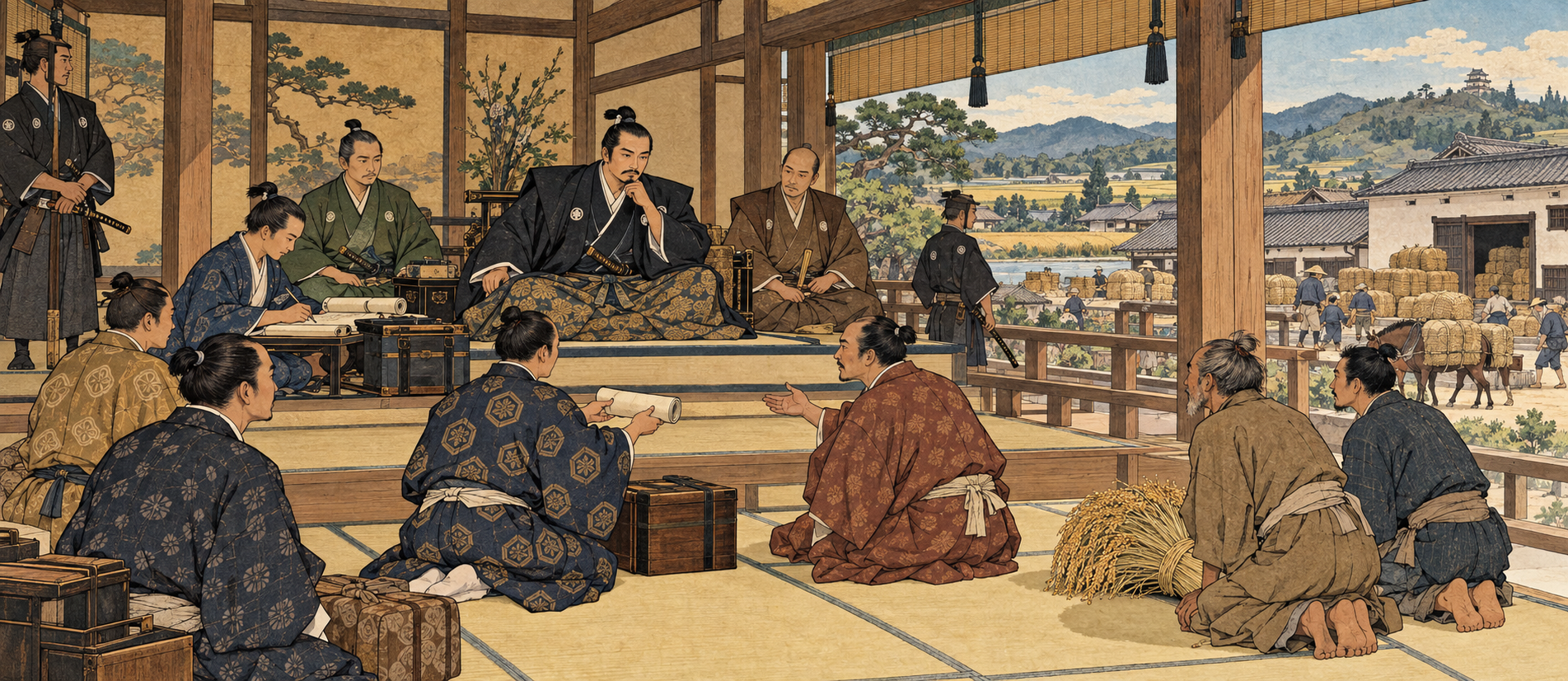
The central houses hold the places through which other men’s wealth must travel: road junctions, storehouses, cultivated corridors and staging grounds. They benefit when northern roads remain open and southern harvests reach their buyers. Peace therefore pays them, though each household has its own idea of the price others should pay to preserve it.
Their influence reaches into Ueno through agents, creditors and marriage connections. None owns the town. Their estates lie along the routes connecting its markets to the wider province, where an interruption can turn a distant quarrel into everyone’s business.
The Nagata — Keepers of the Junction
Nagata Yoshimune, forty-five, holds a fortified residence near the meeting of several important roads. Inns, fodder yards and neighbouring villages support the traffic passing through his lands. His officers organise escorts, investigate roadside theft and collect the dues that travellers dispute whenever the journey becomes difficult.
His wife, Nene, is a cousin of the northern Kitakata lord. Their eldest son, Yoshikatsu, twenty-two, supervises escorts and argues for stronger toll enforcement. Their daughter, Maki, eighteen, is married to the eldest son of the central Ogawa house. Their younger son, Yoshisada, fourteen, resides with the southern Arakawa as security for an agreement protecting traffic between their estates.
At the Nagata court lives Arakawa Masanori, fifteen, nephew of the March Lord. He trains beside the household’s young warriors, hearing complaints about the frontier escorts his uncle provides. Yoshimune’s immediate concern is a succession of attacks whose victims blame his protection while his guards insist the raiders withdraw across another lord’s boundary.
The Ogawa — Lords of the Storehouses
Ogawa Morikiyo, fifty-one, holds productive land around a cluster of granaries and storage yards. His household receives produce awaiting sale or onward transport. Merchants trust his seals, guards and measures sufficiently to leave valuable goods in his custody; maintaining that confidence occupies much of his council’s attention.
His wife, Sugi, comes from a local landed family. Their heir, Moritsugu, twenty-six, is married to Nagata Maki. Their daughter, Tama, twenty, is married into a lesser southern household. Their younger son, Morihisa, sixteen, resides with the Sakai Market Lord, guaranteeing an agreement over stored grain and commercial obligations.
Sakai Naoharu, seventeen, a cousin of the Market Lord, lives at Morikiyo’s court. He studies the accounts and has begun questioning why certain consignments appear under different owners’ names. Morikiyo fears a dispute over pledged rice: several claimants possess credible documents, but there may be insufficient grain to satisfy them all.
The Ishida — Keepers of the Agreements
Ishida Sadamitsu, fifty-four, governs a modest estate whose household has acquired standing through witnessing settlements and holding copies of agreements. Lords bring him boundary disputes, repayment schedules and accusations of broken promises because several rivals will accept his servants as witnesses.
His wife, Yasu, maintains the correspondence that makes this position possible. Their eldest son, Sadayori, twenty-eight, manages the estate and resents the cost of entertaining petitioners. Their daughter, Kayo, twenty-two, is widowed and has returned with her small son. Sadamitsu’s younger brother, Sadatsugu, travels between courts carrying proposals that cannot yet be announced.
His nephew, Sadaharu, fifteen, resides with the elder Fukuchi house; Fukuchi Tadahiro, fourteen, a grandson of Tadamasa’s brother, lives with the Ishida. Their placement guarantees a settlement concerning inherited land. Sadamitsu now faces a dangerous request to authenticate a document that would reopen it. The handwriting appears convincing; the surviving witnesses disagree.
The Okada — Lords of the Muster Ground
Okada Nobukiyo, forty-two, holds open ground and villages capable of supporting assembled troops, pack animals and their attendants. His household arranges provisions, hires additional guards and negotiates service with lesser warriors and rōnin. During a common emergency, other houses need his preparations to make their promised support usable.
His wife, Fumi, is a relative of the southern Fujita house. Their eldest son, Nobutaka, twenty, commands the household men. Their daughter, Hisa, seventeen, remains at home while marriage proposals are considered. Nobukiyo’s younger brother, Nobusada, oversees stores and transport animals.
His younger son, Nobuharu, thirteen, resides with the northern Hioki, guaranteeing an agreement over military passage. At the Okada court lives Hioki Nobumasa, fifteen, nephew of the Pass Lord. Nobukiyo’s present difficulty is payment: men hired for an emergency remain on his grounds after the danger has passed, while the contributing houses dispute their shares of the expense.
The Cost of Keeping Peace
The central houses gain influence by making cooperation possible. They can provide passage, custody, witnesses and provisions, but their usefulness exposes them to claims from every direction. Refusing a request may offend a powerful neighbour; accepting it may make them responsible for an obligation they cannot fulfil.
Their wards and marriages draw northern and southern quarrels into central households. A boy hears his father condemned over dinner. A wife must decide what to report to her birth family. A messenger brings instructions that contradict the agreement his host believes still stands.
For adventurers, central politics begins with work that sounds manageable: escort a consignment, find a witness, establish ownership or deliver wages. The complication comes when fulfilling one promise prevents another from being kept. Whoever resolves the immediate difficulty helps determine which household will be trusted when the next crisis arrives.