
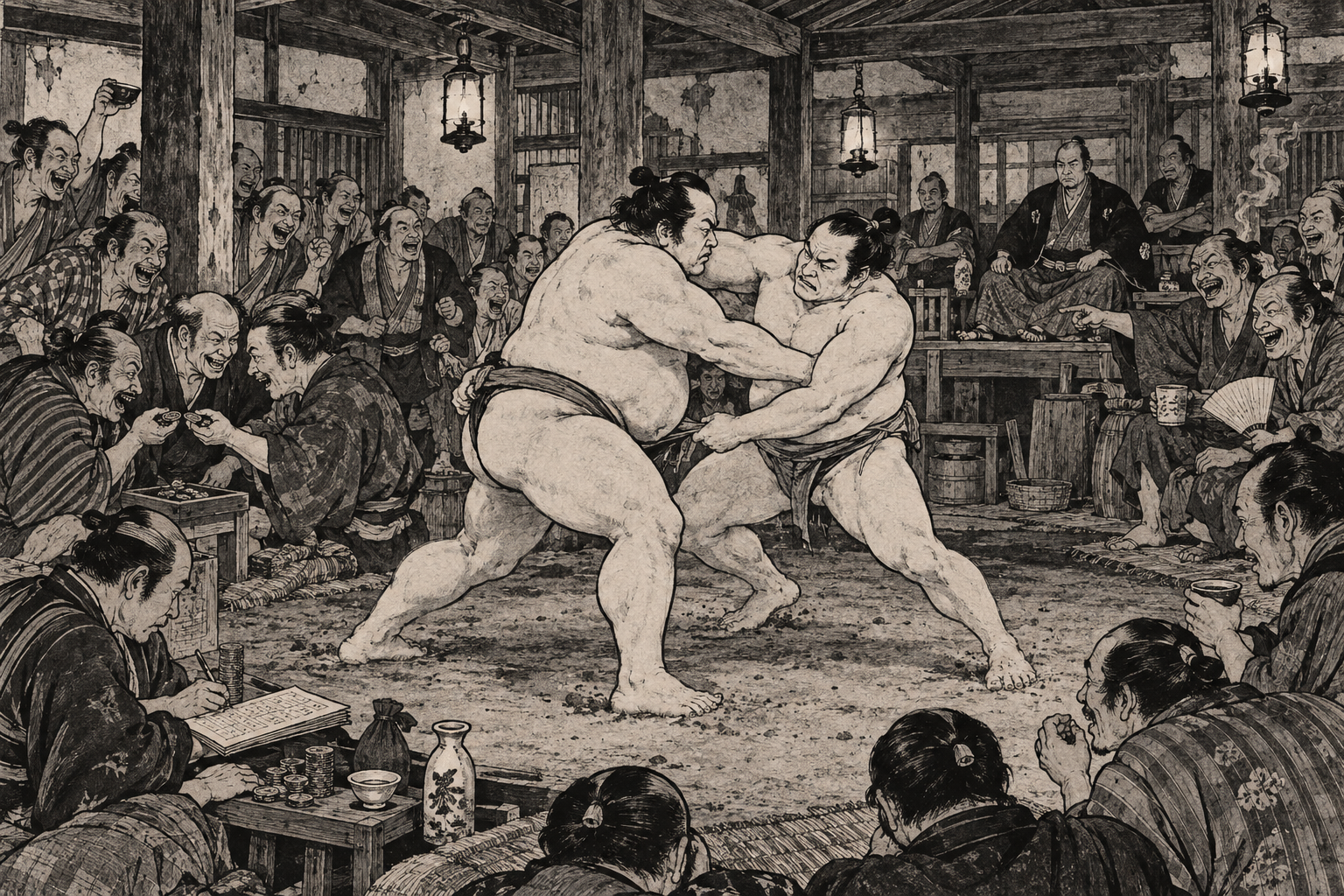
Several of Iga-Ueno’s oyabun maintain Sumai schools. These teach wrestling and provide meeting places for their followers.
Porters, labourers and guards train alongside members of the patron’s organisation. Public bouts attract wagers, recruit pupils and strengthen the oyabun’s standing in his quarter.
Most instructors are Yakuza of Levels 1–3. Their fighting ability comes from sustained practice and experience. A few have mastered Sumai, but most teach ordinary pupils while continuing their own development.
The oyabun supplies premises, supports competitors and appoints the chief instructor. Joining establishes a visible association with his organisation. Ordinary tuition does not automatically make a pupil one of his followers, although recruitment is a regular part of school life.
Daikoku Yard
Patron: Oyabun Kawabata Gen’emon — Level 3 Yakuza.
Daikoku Yard serves the storehouse quarter. Gen’emon’s influence rests upon porters, warehouse labour and introductions between employers and working men. His school occupies a roofed yard behind a provisions store, with a packed-earth wrestling ground and washing facilities.
It is the largest of the three schools and the principal rival of Jōsen’s Foreign Fists. Their pupils compete for employment and reputation. Gen’emon encourages arranged contests because they draw spectators and wagers. He expects disputes to be settled without interrupting business.
“Gen’emon will feed a good wrestler. He will find work for a dependable one.”
Chief instructor: Kawabata Genzaburō — Level 3 Yakuza.
Gen’emon’s younger brother is an experienced wrestler who manages the yard and selects its competitors. He keeps sporting challenges under control and disciplines pupils who make unauthorised threats in the school’s name.
Teaching availability: Daily dawn and evening classes. Admission requires an interview and payment or a recognised sponsor.
| Teaching | Skill score | Mastery |
|---|---|---|
| Sumai | 95 | — |
| Jūjutsu | 75 | — |
| Atemi-waza | 65 | — |
| Gambling | 85 | — |
Assistant instructor: Fujita Denbei — Level 1 Yakuza.
Denbei teaches beginners, maintains the wrestling ground and supervises practice. He also assists with admission money and wagers during public bouts.
| Teaching | Skill score | Mastery |
|---|---|---|
| Sumai | 70 | — |
| Jūjutsu | 55 | — |
| Gambling | 65 | — |
Willow Bank School
Patron: Oyabun Nishimura O-Ren — Level 3 Yakuza.
O-Ren maintains connections among riverside labourers, carriers and the households providing their food and lodging. Her school occupies an enclosed yard behind an inn. Its wrestlers compete at local festivals and travel to bouts in neighbouring towns.
The school has a reputation for orderly conduct. O-Ren uses its success to secure introductions and employment for her followers. She forbids the collection of private debts within the training grounds.
“O-Ren’s wrestlers arrive together, compete together and leave together.”
Chief instructor: Takeda Isuke — Level 3 Yakuza.
Isuke is a former travelling wrestler who settled under O-Ren’s protection. He has mastered Sumai through years of competition. He teaches patiently, keeps account of injuries and oversees arrangements with visiting schools.
Teaching availability: Regular evening classes and additional sessions before competitions. Working pupils may arrange attendance around their duties.
| Teaching | Skill score | Mastery |
|---|---|---|
| Sumai | 99 | Master |
| Jūjutsu | 80 | — |
| Karumijutsu | 65 | — |
| Gambling | 75 | — |
Assistant instructor: Nishimura Kichizō — Level 2 Yakuza.
O-Ren’s nephew receives visiting competitors and teaches ordinary classes. He also accompanies the school’s wrestlers when they travel.
| Teaching | Skill score | Mastery |
|---|---|---|
| Sumai | 80 | — |
| Jūjutsu | 65 | — |
| Gambling | 70 | — |
Red Gate School
Patron: Oyabun Araki Jūbei — Level 3 Yakuza.
Jūbei’s school stands near the market approaches, behind premises used for gaming and entertainment. It draws market labourers, guards and young men seeking a place within his following. Its bouts are noisy, well attended and closely associated with wagering.
Jūbei rewards successful competitors openly. His patronage brings employment and protection, but pupils may be pressed to undertake services for his organisation. The chief instructor regularly disputes how much their attendance entitles Jūbei to demand.
“At Red Gate, everyone knows who won—and who backed him.”
Chief instructor: Matsuda Gorōzaemon — Level 4 Yakuza.
Gorōzaemon is the exceptional senior figure among these schools. He is a veteran wrestler and longstanding member of Jūbei’s organisation. His authority allows him to resist the patron’s interference, although he remains involved in its affairs.
He insists that challenges be agreed before witnesses and that competitors observe the terms.
Teaching availability: Daily classes for accepted pupils. Admission requires his approval. Applicants attached to another oyabun must disclose that relationship.
| Teaching | Skill score | Mastery |
|---|---|---|
| Sumai | 99 | Master |
| Jūjutsu | 85 | — |
| Atemi-waza | 75 | — |
| Gambling | 90 | — |
Assistant instructor: Araki Shinsuke — Level 2 Yakuza.
Shinsuke supervises conditioning and teaches younger pupils. He is loyal to Jūbei and readily recruits students for work within the organisation.
| Teaching | Skill score | Mastery |
|---|---|---|
| Sumai | 80 | — |
| Atemi-waza | 65 | — |
| Jūjutsu | 60 | — |
| Gambling | 75 | — |
Rivalry and Membership
The schools exchange challenges and compete for pupils. Their patrons negotiate the conditions and stakes of major bouts. Disputed results, injuries and unpaid wagers can turn sporting rivalry into a quarrel between organisations.
Most pupils and ordinary followers are Level 1 or 2. Experienced competitors and trusted organisers may reach Level 3. Figures above that level are uncommon.
A pupil seeking instruction must consider the association that comes with it. Moving between schools requires tact, especially when their patrons are in dispute. Gambling instruction is arranged separately and generally reserved for pupils accepted into the patron’s confidence.
Ordinary and Secret Instruction
These are campaign statistics for FGU Bushido. Skill scores of 99 indicate mastery; character Level is listed separately.
The tables describe ordinary teaching. Some senior instructors possess deeper techniques or are developing them through practice. Such knowledge remains within the school and becomes available through trust, obligations and events in play.