
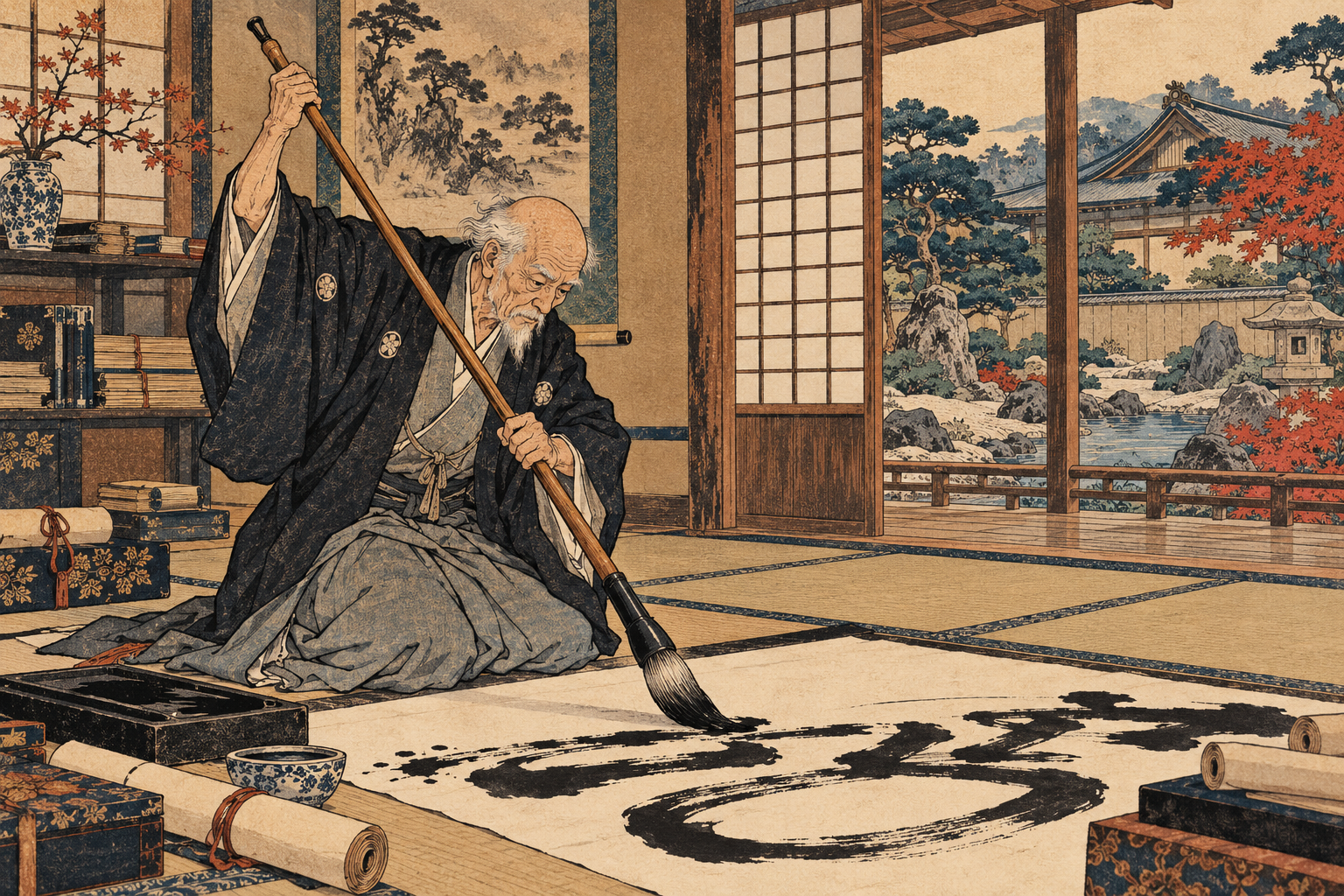
Seishinkan is Iga-Ueno’s most prestigious gentleman’s academy.
For three generations it has educated the sons of local warrior families in arms, letters and command. Its former pupils serve as household officers, estate stewards and commanders throughout the province. Their continued patronage supports the school, and their achievements are recorded on wooden boards in its reception hall.
The academy was founded by Fujibayashi Masanori, a campaigning samurai who established a permanent teaching house upon retiring from service. He secured land and support from several local families and religious patrons. His insistence that a warrior should be able to read an agreement, govern his household and command men became the school’s defining principle. His descendants have maintained those connections without placing the academy under the exclusive authority of any one lord.
Its present owner and chief instructor is his grandson, Fujibayashi Masatsugu. He inherited the academy after years of teaching and service as a household officer. He is respected for his swordsmanship, restrained manner and refusal to favour wealthy pupils in the training hall.
“Masatsugu will bow to your father’s name. Your sword must answer for itself.”
— A saying among Seishinkan’s former pupils
The academy’s greatest distinction is the residence of Ōkura Sōhaku, an elderly calligrapher whose reputation reaches well beyond Iga. His presence draws patrons and students who would otherwise seek instruction in a larger city. Masatsugu considers keeping him at Seishinkan an honour inherited from his grandfather.
The Academy
Seishinkan occupies a walled compound containing a reception hall, schoolroom, covered dōjō, archery ground, stables and a small residential wing. Its furnishings are well maintained, and its public rooms display gifts from former pupils. Religious patrons support memorial observances and contribute manuscripts to its library.
The curriculum combines swordsmanship, archery, horsemanship and military knowledge with literacy, calligraphy and classical study. Instruction follows a fixed schedule. Students are expected to arrive properly dressed, maintain their equipment and observe the precedence of senior pupils.
Admission normally requires a family introduction or recognised sponsor. Most students are samurai, although a reputable rōnin may be admitted. Private lessons are available by arrangement. Fees support ordinary instruction; access to the school’s deeper teachings depends upon the instructor’s trust and the student’s relationship with the academy.
Chief Instructor Fujibayashi Masatsugu
Level 5 Bushi. Owner and head of the academy.
Masatsugu directs the curriculum, admits students and teaches advanced swordsmanship. He retains responsibility for the conduct of the school’s instructors and represents Seishinkan before its patrons. His teaching is precise, with particular attention to distance, timing and maintaining control under pressure.
Teaching location and availability: The main dōjō. He conducts regular senior classes and accepts private pupils following an interview. His availability is reduced when academy business requires travel.
| Teaching | Skill score | Mastery |
|---|---|---|
| Kenjutsu | 99 | Master |
| Iaijutsu | 90 | — |
| Bajutsu | 85 | — |
| Senjojutsu | 90 | — |
| Japanese Classics | 80 | — |
| Rhetoric | 75 | — |
Senior Weapons Instructor Tsuge Munekatsu
Level 4 Bushi.
Munekatsu served as an armed retainer before joining the academy. He teaches most of its ordinary weapons classes and supervises practice when Masatsugu is absent. He is blunt, reliable and less concerned with polished manners than the chief instructor.
Teaching location and availability: The main dōjō and outdoor practice yard. Regular instruction is available to all enrolled martial students. Private tuition is arranged through the academy.
| Teaching | Skill score | Mastery |
|---|---|---|
| Kenjutsu | 90 | — |
| Sōjutsu | 99 | Master |
| Naginatajutsu | 85 | — |
| Jūjutsu | 80 | — |
| Iaijutsu | 75 | — |
Archery and Riding Instructor Momochi Sadayoshi
Level 4 Bushi.
Sadayoshi manages the archery ground, horses and riding instruction. Formerly responsible for mounted messengers and escorts, he brings practical knowledge of travel and the care of animals to his teaching. He is patient with inexperienced students but strict about unsafe handling.
Teaching location and availability: The archery ground, stables and riding ground outside town. Archery classes run regularly. Riding lessons require advance booking and access to a suitable horse.
| Teaching | Skill score | Mastery |
|---|---|---|
| Kyūjutsu | 99 | Master |
| Bajutsu | 95 | — |
| Kenjutsu | 75 | — |
| Senjojutsu | 75 | — |
| Hawking | 80 | — |
Military Instructor Hattori Tomonobu
Level 3 Bushi.
Tomonobu teaches military organisation and the duties of command. He formerly served as a junior officer responsible for watches, stores and defensive works. He maintains the academy’s collection of maps and written accounts of campaigns.
Teaching location and availability: The military schoolroom and practice yard. Scheduled instruction is open to enrolled students. Private consultation requires Masatsugu’s approval when it concerns an active dispute between local families.
| Teaching | Skill score | Mastery |
|---|---|---|
| Senjojutsu | 90 | — |
| Chikujo-jutsu | 85 | — |
| Sōjutsu | 80 | — |
| Kenjutsu | 75 | — |
| Heraldry | 85 | — |
| Rhetoric | 70 | — |
Scholarly Instructor Ōkura Kiyohide
Level 3 Bushi.
Kiyohide teaches the academy’s literary subjects and manages its correspondence. A former household secretary, he also maintains admission records, tuition accounts and the register of former pupils. He is courteous, observant and closely acquainted with the families supporting the school.
He is Sōhaku’s grandson and handles the elderly master’s appointments. Most students learn their foundations under Kiyohide before being considered for his grandfather’s instruction.
Teaching location and availability: The schoolroom and library. Regular classes are available to enrolled students. Separate enrolment for literary instruction is possible with a sponsor’s recommendation.
| Teaching | Skill score | Mastery |
|---|---|---|
| Calligraphy | 99 | Master |
| Japanese Classics | 90 | — |
| Chinese Classics | 85 | — |
| Kanji literacy | 95 | — |
| Hiragana literacy | 99 | Master |
| Katakana literacy | 90 | — |
| Rhetoric | 85 | — |
| Kenjutsu | 65 | — |
Master Calligrapher Ōkura Sōhaku
Level 6 Bushi. Retired from martial practice. Age 84.
Sōhaku is the jewel in Seishinkan’s crown. His brush name appears on temple dedications, presentation scrolls and treasured correspondence held by prominent households. He spent much of his life serving as a secretary and scholar before settling permanently at the academy. He knew its founder and has taught all three generations of its owners.
His back is bent, his hearing poor and his movements slow, but his brush remains steady. He speaks little during instruction and expects corrections to be remembered. His judgement carries considerable weight among the academy’s patrons. A work bearing his seal is a valued possession; his acceptance of a pupil is a distinction in its own right.
“A lord may purchase one of Sōhaku’s scrolls. He cannot purchase Sōhaku’s approval.”
— Ōkura Kiyohide
Teaching location and availability: A quiet room overlooking the inner garden. He teaches on two mornings each week when his health permits. Kiyohide selects work for his consideration; Sōhaku decides whom he will receive. He occasionally accepts a promising beginner, regardless of family standing.
| Teaching | Skill score | Mastery |
|---|---|---|
| Calligraphy | 99 | Master |
| Chinese Classics | 99 | Master |
| Japanese Classics | 99 | Master |
| Kanji literacy | 99 | Master |
| Hiragana literacy | 99 | Master |
| Katakana literacy | 99 | Master |
| Meditation | 95 | — |
| Poetry | 95 | — |
Sōhaku’s advanced instruction concerns composition, interpretation and the development of an individual hand. His surviving military skills are outside the academy’s teaching provision.
Ordinary and Secret Instruction
These are campaign statistics for FGU Bushido, using Skill scores up to 99, with mastery marked separately from character Level. The tables record instruction available through ordinary enrolment, subject to each teacher’s admission requirements.
Seishinkan’s senior martial instructors also preserve and develop Okuden according to their interests. Students may occasionally witness their effects, but the techniques are held within the school. Learning them as a coherent body of knowledge requires a deeper relationship with both teacher and academy. The nature of those teachings, and the circumstances under which they are entrusted to a character, develop through play.